
The Short Bench: Inside the Small Circle of Developers Remaking San Antonio
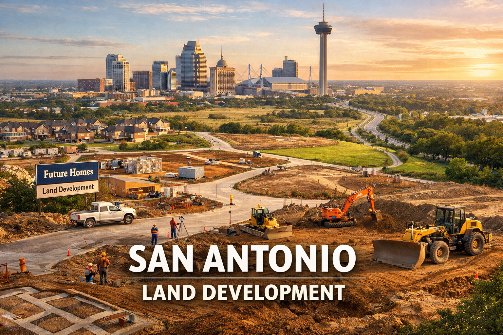
Ask anyone deep inside San Antonio’s real estate scene how many people are actually steering the city’s biggest projects, and you will hear a version of the same answer: it is a surprisingly short list. One local developer who chairs the Urban Land Institute’s San Antonio chapter has described the city’s development community as “not a long bench,” though a notably collaborative one. For a metro area pushing past 2.6 million people and currently juggling a multi-billion-dollar downtown sports district, a historic skyscraper conversion, and an industrial corridor attracting names like Microsoft and Vantage Data Centers, that is a striking thing to hear. It also happens to be true, and understanding why tells you almost everything about how this city actually gets built.
This is not a list of every company with a sign on a fence somewhere in Bexar County. It is a look at the handful of developers and projects currently defining what San Antonio becomes over the next five years, and why the city’s development culture works the way it does.
A Hometown Habit That Shapes the Skyline
San Antonio has an unusual trait among fast-growing American cities: most of the people building it actually live in it. As one Hixon Properties executive put it, doing the work in your own hometown means you cannot put a “crummy product on the ground” — you have to answer for it to your friends and family. That sentiment shows up constantly when you talk to people in this industry, and it explains a development culture that leans more toward long-term reputation building than fast-flip opportunism.
It also means capital, not ambition, tends to be the real constraint. The same developer pointed to a shortage of deep-pocketed equity as the binding limitation on the local scene, noting how risky real estate development actually is and how few outside players have entered the market compared to other major metros. That scarcity has kept the circle of major players tight, but it has also meant the people in it tend to know each other, and increasingly, work with each other.
The Names Behind the Skyline Right Now
A handful of firms and individuals come up again and again when San Antonio’s current building boom gets discussed.
Area Real Estate, founded by David Adelman in 2011, has become one of the more visible forces reshaping downtown. Adelman has overseen residential projects including The Maverick, The ’68, and 1221 Broadway, alongside mixed-use, industrial, and office developments. One of the firm’s most talked-about current efforts is The Creamery, an adaptive reuse project transforming the historic Borden Creamery complex in Tobin Hill into a mixed-use destination. Adelman has also been candid about his management style, suggesting that a degree of healthy disagreement during the development process tends to sharpen rather than weaken the final outcome — and he has signaled growing interest in tackling the city’s affordable housing shortage directly.
Hixon Properties delivered one of the more technically notable projects in the state with the Soto Building on Broadway. It stands as the first true mass timber building of its size and scale anywhere in Texas, part of a broader cluster of catalytic projects reshaping South Broadway into one of downtown’s more dynamic corridors.
Oxbow, the development arm of Silver Ventures, remains the company most credited with proving San Antonio’s adaptive reuse model could work at scale. Led by CEO Bill Shown, Oxbow transformed an abandoned brewery in Tobin Hill into the Pearl, now a mixed-use destination anchored by food and hospitality, and has since expanded into Lavaca with the Southtown Aldea project.
Casey Development brings a different kind of track record — pure scale over a long runway. With more than 25 years in the business, the firm has developed in excess of three million square feet of commercial real estate across the San Antonio area, built on a strategy the company describes as identifying unique opportunities and moving on them decisively.
Other names shaping specific districts include James Lifshutz, the developer behind the Blue Star Arts Complex and Hot Wells, who is currently working on redeveloping the Zona Cultural area west of City Hall and parcels along Roosevelt Avenue and East Southcross Boulevard, and GrayStreet Partners and Weston Urban, two firms whose pipeline of downtown projects has made them essential relationships for contractors trying to get ahead of public bid announcements.
The Project Reshaping Everything Else: Project Marvel
No conversation about San Antonio real estate in 2026 gets far without running into Project Marvel, the sports and entertainment district proposed for Hemisfair and the Alamodome footprint southeast of downtown. The district carries an estimated price tag between three and 4.5 billion dollars, anchored by a new Spurs arena, an expanded Henry B. González Convention Center, and roughly 500,000 square feet of non-arena commercial space.
The arena itself is the centerpiece. Estimated between 1.2 and 1.5 billion dollars, it is proposed for a 13.9-acre site at the former Institute of Texan Cultures, with the broader district also including a 1,000-key convention hotel, Alamodome upgrades, conversion of the John H. Wood Jr. Federal Courthouse into a 5,000-seat event venue, a land bridge over Interstate 37, and 50 to 62 acres of additional mixed-use development covering apartments, retail, restaurants, and parks. The financing structure has its own momentum: the arena alone is expected to draw $489 million from the City of San Antonio and $500 million from the Spurs organization, on top of a $1.5 billion development commitment from the team. As of late 2025, the city’s Institute of Texan Cultures building had already been largely demolished to make way for construction, and the Planning Commission had approved acquiring an adjacent federal office property and parking lots within the project footprint.
For developers and investors watching this project, the significance extends well beyond the arena itself. A district of this scale tends to pull surrounding land values, hospitality demand, and multifamily interest along with it — which is exactly the pattern already showing up around Hemisfair.
Downtown’s Other Major Bets
Project Marvel is the biggest story, but it is far from the only one. The Tower Life Building, a 31-story fixture of San Antonio’s skyline since 1929, is currently being converted from largely vacant office space into 243 residential apartments, with street and river-level restaurants and retail folded into the plan. The renovation is expected to wrap up in the second half of 2026 and represents one of the clearest signals yet that downtown’s office-to-residential conversion wave has real momentum here.
Hospitality has also been quietly stacking up downtown. The Monarch San Antonio, a 17-story, 200-room hotel near Hemisfair, is set to open in early 2026, joining other recent additions including a 347-room luxury property on South Alamo Street and a smaller 77-room hotel near the River Walk. Each of these properties is being read by commercial brokers less as a standalone bet and more as a leading indicator for office and multifamily demand in the surrounding blocks.
Meanwhile, the Continental Block Development between Dolorosa and West Commerce streets continues a broader push to revitalize the historic core, and the San Pedro Creek Culture Park — a project that began in 2017 and is expected to reach full completion in 2026 — continues adding walking trails, art installations, and mixed-use development opportunities along the waterway running through downtown.
Growth Is Not Staying Downtown
While the urban core captures most of the headlines, some of the most active development right now is happening well outside it. Merit Commercial Real Estate is leasing up Schertz Station, a 72-acre master-planned, mixed-use development at Interstate 35 and Cibolo Valley Drive, which has already signed national retailers and restaurant chains as anchor tenants. On the South Side, Gilley International is positioning Villaret Commons as the first of several planned residential communities for that part of the city.
Retail is following rooftops just as predictably on the Far Westside. The Atrium of Arcadia, an 8,000-square-foot retail center under construction along Potranco Road, broke ground in late 2025 and is targeting a May 2026 opening, built specifically to serve the rapidly growing Alamo Ranch and Arcadia Ridge communities nearby.
The industrial sector tells perhaps the most consequential growth story of all, even if it gets less popular attention than arenas and apartment towers. San Antonio’s industrial real estate market is being driven by a surge in logistics, manufacturing, and data center investment concentrated along the I-35 corridor, with major operators including Microsoft, Vantage Data Centers, and CyrusOne reflecting growing interest in the region’s available land, energy infrastructure, and long-term planning capacity. Builders FirstSource is set to begin construction on a 93,000-square-foot manufacturing warehouse in early 2026, part of a broader pattern of cross-border trade and supply chain investment that shows little sign of slowing.
What This Means for Anyone Watching the Market
The throughline across all of this activity is that San Antonio’s development scene, while small in terms of who holds the reins, is unusually active in terms of what is actually getting built. A handful of names — Adelman, Shown, Lifshutz, the Hixon and Casey organizations — keep showing up across very different project types, from adaptive reuse to mass timber office buildings to entire neighborhood-scale residential communities.
That concentration cuts both ways. It means relationships matter enormously here; contractors, suppliers, and investors who understand a given firm’s pipeline and priorities have a real advantage over those simply chasing public bids after the fact. It also means the next wave of growth in San Antonio real estate may depend less on whether demand exists — population growth and economic diversification have settled that question—and more on whether enough new capital and new players are willing to step into a market that has, until now, mostly built itself from the inside.
Given what is currently under construction, from a multi-billion-dollar entertainment district to a 1929 skyscraper getting a second life as modern housing, the appetite for that growth clearly is not in question. What remains to be seen is who joins the short bench next.