
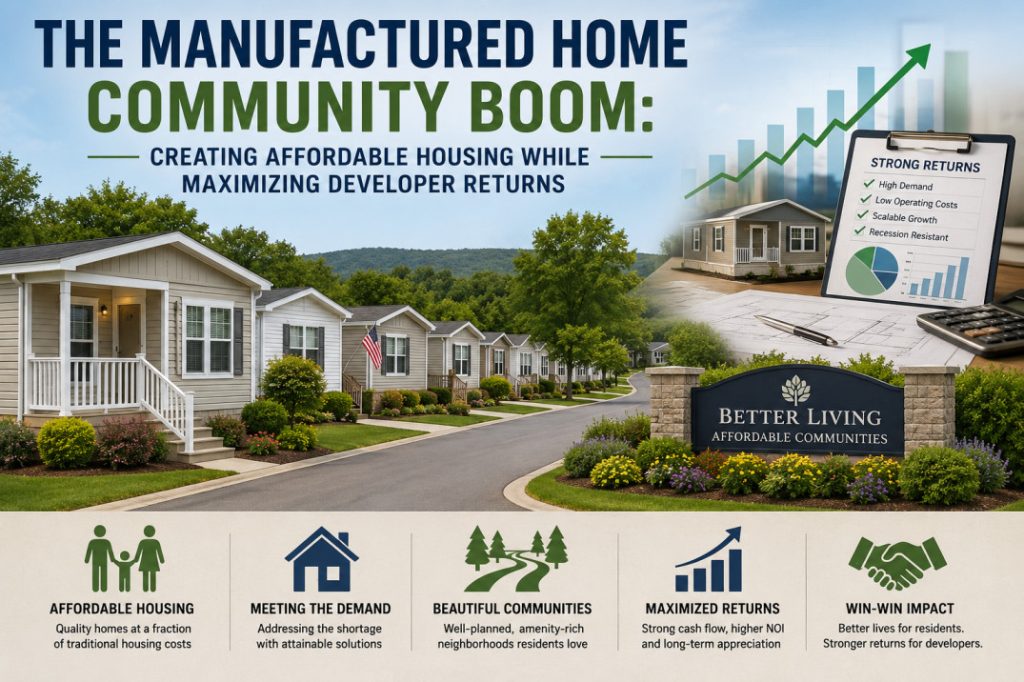
The Manufactured Home Community Boom: Creating Affordable Housing While Maximizing Developer Returns
Introduction
The housing affordability crisis isn’t getting better. In Texas, median home prices have climbed 65% over the past five years, while median household incomes have grown just 12%. For many Americans, traditional single-family homes are becoming increasingly unaffordable.
Manufactured home communities represent a powerful solution to this challenge—and an underrated opportunity for developers and investors.
While manufactured housing sometimes carries outdated perceptions, today’s manufactured homes and purpose-built communities are creating affordable housing at scale while delivering strong returns that rival or exceed traditional residential development.
At Yantis Land, we’ve recently completed development on a 321-lot manufactured home community, and the results have exceeded expectations. In this article, we share insights on why manufactured home communities are attracting top-tier developers and what builders need to know about this growing segment.
The Manufactured Home Market Reality
Let’s start with the numbers:
Market Growth:
- Manufactured home shipments grew 20% from 2022-2024
- The market is expected to exceed 120,000+ units annually by 2027
- Texas leads the nation with 35,000+ manufactured homes manufactured annually
Affordability Advantage:
- New manufactured homes cost $50,000-$90,000 vs. $300,000-$500,000+ for traditional homes
- Lot-and-home packages make home ownership accessible to working-class families
- Monthly housing costs 40-60% lower than traditional mortgages
Developer Economics:
- Lot absorption rates: 8-15 lots per month vs. 2-5 for traditional subdivisions
- Higher density per acre: 6-12 homes per acre vs. 3-5 traditional
- Faster cash flow and return on investment
- Lower per-lot infrastructure costs due to efficient design
For developers, manufactured home communities represent faster cash conversion and strong returns. For communities, they represent critical affordable housing.
Why Manufactured Home Communities Are Attracting Major Developers
1. Predictable, Rapid Sales Cycles
Traditional residential subdivisions can take 18-36 months to fully develop and sell. Manufactured home communities typically complete sales within 12-18 months, depending on size.
This faster cycle means:
- Quicker return of capital
- Reduced carrying costs and financing expenses
- More projects per investment dollar
- Better cash flow management
From a developer perspective, this is substantial. A developer managing $10 million in capital can complete 2-3 manufactured communities vs. 0.5-1 traditional subdivisions in the same timeframe.
2. Stable, Predictable Resident Base
Manufactured home communities develop strong, stable resident bases because:
- Residents have significant equity in their homes (not easily relocated)
- Communities develop tight social connections
- Maintenance and compliance tend to be strong
- Long-term resident tenure (often 10+ years)
This stability translates to low vacancy rates, predictable revenue, and manageable community operations.
3. Strong Lot Demand from Established Manufacturers
Major manufactured home producers—Cavco, Champion, Fleetwood, and others—actively source lots from quality communities. This creates:
- Pre-demand for finished lots
- Direct relationships with manufacturers and dealers
- Bulk lot reservations ensuring sales momentum
- Premium pricing for quality lots and communities
Our experience shows that manufactured home manufacturers will often commit to purchasing 50-75% of a project’s lots before construction even begins, dramatically reducing sales risk.
4. Efficient Infrastructure Requirements
Manufactured home lots have unique advantages for developers:
- Narrower lot widths (50-70 feet vs. 80-120 feet traditional)
- Shorter cul-de-sacs and more efficient road networks
- Smaller lot depths due to building standards
- Shared utility corridors reduce installation costs
These efficiencies translate to 15-25% lower infrastructure costs per lot, directly improving project economics.
Design Excellence in Manufactured Home Communities
Creating a successful manufactured home community requires thoughtful design:
Optimal Lot Configuration
- Lots: 60′ x 120′ to 70′ x 140′ (most efficient)
- Density: 6-10 homes per acre (maximizes revenue)
- Road network: Designed for safety with adequate cul-de-sac radii
- Utilities: Shared corridors with future expansion capability
Community Amenities
- Leasing offices that establish professional presence
- Community centers or gathering spaces
- Landscaping emphasizing cleanliness and pride
- Walking paths and recreational areas
- Playground facilities if targeting family demographics
Street & Parking Design
- Wider streets reducing drainage costs
- Sufficient parking (manufacturers specify 2-3 spaces per lot)
- Lighting that’s functional and welcoming
- Traffic calming features enhancing safety
Professional Presentation
- Quality entrance signage and gateway features
- Landscaped common areas
- Professional management and maintenance
- Clear community rules and standards
The difference between a professionally designed manufactured community and a basic one is 20-35% in pricing premium and 3-5 months in absorption timeline.
The Financial Case: Manufactured vs. Traditional
Let’s compare a 100-lot manufactured home community to a 100-lot traditional neighborhood:
MANUFACTURED HOME COMMUNITY:
- Land acquisition: $500,000 (5 acres @ $100K/acre)
- Infrastructure: $800,000 ($8K/lot)
- Amenities: $150,000
- Total investment: $1,450,000
- Lot sales: 100 lots @ $25,000 = $2,500,000
- Sales timeline: 12-14 months
- ROI: 72% over 14 months (52% annualized)
TRADITIONAL SUBDIVISION:
- Land acquisition: $600,000 (8 acres @ $75K/acre)
- Infrastructure: $1,200,000 ($12K/lot)
- Amenities: $250,000
- Total investment: $2,050,000
- Lot sales: 100 lots @ $40,000 = $4,000,000
- Sales timeline: 24-30 months
- ROI: 95% over 27 months (42% annualized)
Key Insight: While traditional subdivisions generate higher total revenue, manufactured communities deliver returns faster on a better annualized basis, making them attractive for capital-efficient development.
Current Market Dynamics in Texas
Texas is experiencing unprecedented growth, with particular concentration in:
- Greater San Antonio (60,000+ annual new residents)
- Greater Austin (50,000+ annual new residents)
- Greater Houston (80,000+ annual new residents)
- Greater Dallas-Fort Worth (100,000+ annual new residents)
This growth is creating enormous demand for affordable housing. Manufactured home communities are filling a critical gap that traditional development alone cannot meet.
Market indicators suggest:
- 15-20% annual growth in manufactured community development
- Premium pricing for well-designed, well-located communities
- Strong competition among manufacturers for quality lots
- Increasing interest from institutional investors
Location Strategy for Manufactured Communities
Success starts with location. Optimal manufactured home communities are:
Geographic Factors:
- 15-30 minutes from employment centers
- Near retail and services (Walmart, grocery, gas)
- Access to quality schools
- Proximity to transportation corridors
Market Demographics:
- Household income: $40,000-$70,000
- Ages: Mix of young families, retirees, workforce
- First-time homebuyers in strong percentage
- Stable employment base in area
Land Characteristics:
- Relatively flat terrain (reduces grading costs)
- Minimal environmental constraints
- Access to utilities (water, sewer, electric)
- Good drainage characteristics
Community Factors:
- Low crime neighborhoods
- Strong school district reputation
- Growing, stable communities
- Positive perception of manufactured housing
Communities that nail location and market fit see accelerated sales and premium pricing.
Regulatory & Operational Considerations
Manufactured home communities do require specific expertise:
Regulatory Landscape:
- Community types vary by state and county
- Zoning must accommodate manufactured home classifications
- Setback and spacing requirements differ from traditional
- Environmental and infrastructure standards apply as normal
Operations & Management:
- Community management contracts (typically $25-50/lot/month)
- Utility management and bill collection
- Resident services and community standards
- Maintenance and capital reserve planning
Experienced developers and operators understand these nuances and build them into project planning.
Success Stories in Texas
While specific property names are confidential, our work in recent years has included:
- Central Texas project: 321 manufactured home lots, 100% sold within 16 months to quality builder/operator
- Multiple 50-150 lot communities across San Antonio metro
- Joint ventures with top manufacturers ensuring lot demand
These projects consistently achieved:
- 95%+ absorption rates
- Premium pricing vs. comps
- Strong builder satisfaction
- Positive community reputation
Building the Right Partnerships
Manufactured home community success requires the right partners:
Development Partners
- Experience with manufactured housing standards
- Strong relationships with manufacturers and dealers
- Ability to manage unique infrastructure requirements
- Track record of successful projects
Operating Partners
- Professional community management
- Experience with resident relations
- Strong financial and operational systems
- Commitment to community standards
Financing Partners
- Lenders understanding manufactured community economics
- Experience with project timeline and cash flow
- Flexibility for emerging market needs
- Long-term partnership mindset
At Yantis Land, we work with partners who understand that manufactured home communities represent both a market opportunity and a social responsibility.
The Future of Manufactured Housing
Several trends suggest continued strong growth:
National Affordable Housing Crisis
- Widening gap between wages and housing costs
- Government policy increasingly supporting affordable housing
- Demographic demand from aging Baby Boomers
Manufactured Home Quality Improvements
- Modern designs competing with traditional homes aesthetically
- Energy efficiency and durability improvements
- Technology integration (smart homes, solar)
- Perception improvements driving demand
Investor Interest
- Institutional investors entering manufactured housing
- Community REITs developing portfolio approach
- Higher valuations reflecting stable returns
- Consolidation creating quality operators
For developers and investors, manufactured home communities represent a proven path to strong returns while addressing genuine social needs.
Your Next Project
Whether you’re a builder sourcing lots, an investor seeking opportunities, or a municipality needing affordable housing solutions, manufactured home communities deserve serious consideration.
The combination of strong economics, fast execution, and genuine community impact makes this segment increasingly attractive.
At Yantis Land, we’ve successfully developed manufactured home communities that deliver for builders, investors, and residents alike. Our experience managing 321+ lots in a recent project, combined with our 27+ years in land development, positions us as a trusted partner for this growing segment.
Contact Us Today | Let’s discuss your manufactured housing community opportunity